By: Ronda Holman
If your state lets an assistant do it, doing it yourself isn’t diligence — it’s a scheduling leak you’re choosing to keep.
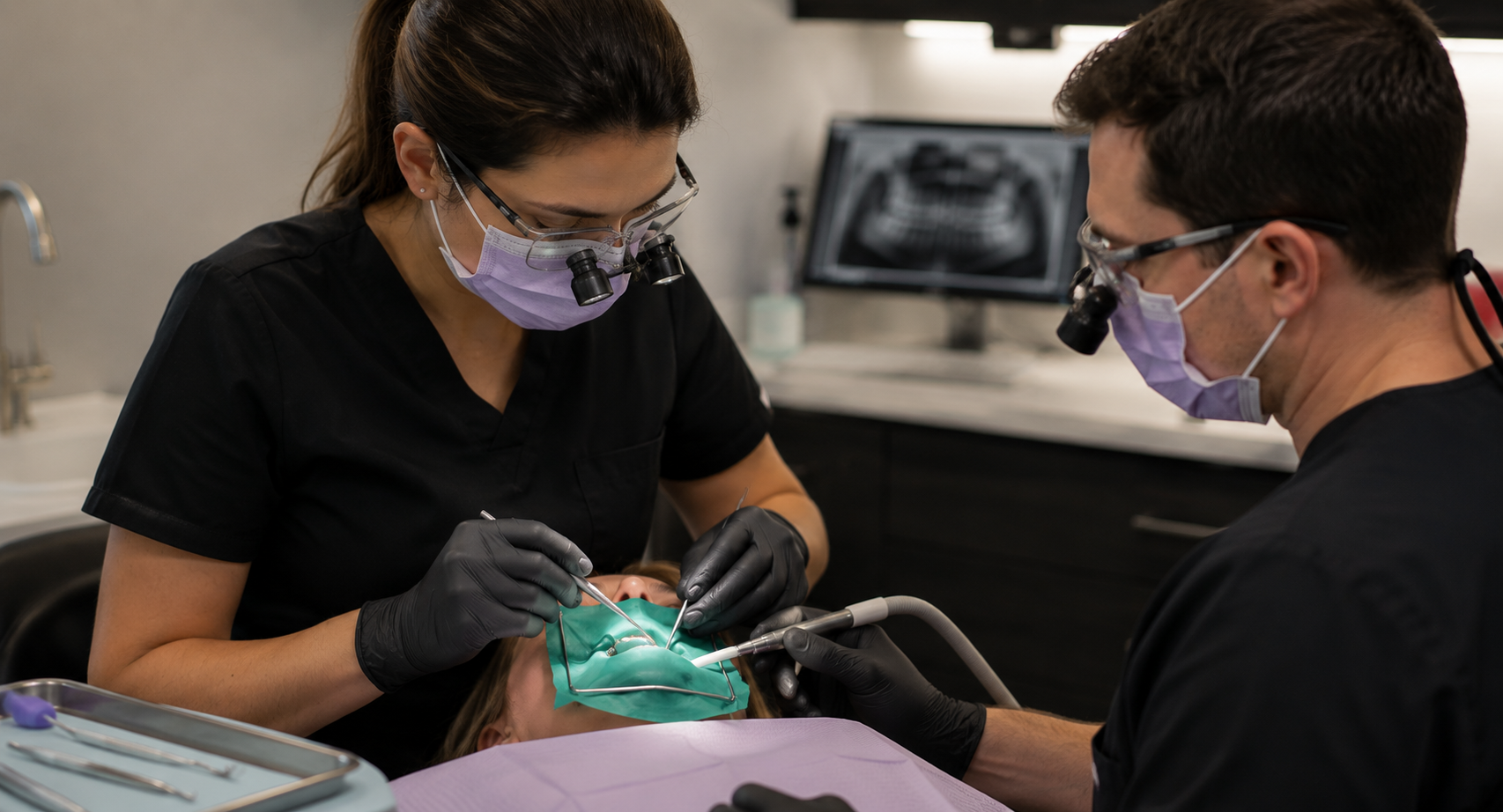
Watch a new dentist run a restorative day and you’ll usually find the same quiet inefficiency: the doctor personally placing every rubber dam. It feels responsible. It feels like control. It’s actually one of the clearest signs that a practice hasn’t learned to use its team, and it’s costing you the most expensive minutes in the building.
First, the Legal Reality
Rubber dam placement and removal is one of the most commonly delegable expanded functions in the country. States like Pennsylvania, Maine, South Dakota, and Louisiana explicitly authorize a trained or certified expanded-function dental assistant to place and remove rubber dams under a dentist’s supervision.
But, and this is the whole ballgame, it is governed entirely by your state’s Dental Practice Act. Who may place a dam, what certification or training they need, and what level of supervision is required all change the moment you cross a state line.
So before you delegate anything, verify.
The two authoritative references are the DANB State Fact Booklet and the ADA’s Survey of Legal Provisions for Delegating Intraoral Functions to Dental Assistants and Dental Hygienists, and when those disagree with your reading, your state board wins.
This isn’t a suggestion. Delegating a function your state reserves is a licensing problem, not an efficiency win. Confirm it in writing, document your assistant’s training, and then build the workflow.
The Time Math You’re Ignoring
Once it’s legal in your operatory, the argument is almost embarrassingly simple.
Your chair time is the single most expensive labor cost in the practice. Every minute you spend punching a dam, seating a clamp, and inverting the margins is a minute you are not diagnosing, prepping, or moving to the next column.
If dam placement eats four to six minutes a case and you delegate it while you’re reviewing radiographs, dictating the last chart, or greeting your next patient, you’ve just recovered that time at the highest possible return.
Multiply it across a restorative or endo-heavy day and you’re not saving minutes, you’re recovering appointments.
The dentists who feel perpetually behind are very often the ones personally performing every delegable task on the schedule. The bottleneck isn’t the calendar, it’s the doctor.
Your Assistant Will Get Better at It Than You
Here’s the part that bruises egos, so I’ll be blunt: with proper training and reps, a good assistant becomes better at isolation than you are. Not equal — better. And the reason is boring and undeniable. They do it all day. You do it between everything else. Isolation is a motor skill, and motor skills belong to whoever gets the volume. The person placing thirty dams a week will out-execute the person placing them in the gaps between preps and hygiene checks every time.
That matters more than convenience, because isolation quality is not cosmetic. A dry, well-inverted field is the precondition for durable adhesive bonding and for predictable endodontics — moisture control is where restorations quietly succeed or fail.
So an assistant who owns dam placement and gets genuinely excellent at it isn’t just saving you time; they are very likely raising the quality of the field you restore into. You are trading a task you’re mediocre at for an outcome you actually want.
Delegation Is a Clinical Skill, Not a Personality Trait
New dentists tend to treat delegation as something that happens to a practice once it gets big enough. It’s the reverse. Delegation is a skill you build deliberately: you train the assistant to your standard, you define what “checked and ready” looks like, you inspect the field before you touch the tooth, and you keep the responsibility that supervision requires. Done right, it doesn’t feel like letting go. It feels like finally running the operatory as a team instead of a solo act with helpers.
That’s also the version of practice ownership worth building toward — one where every person is working at the top of their allowable scope, the schedule breathes, and your hands are reserved for the things only your license permits. That practice isn’t an accident of growth. You design it, one delegated function at a time, and rubber dam placement is the easiest place to start.
So check your state law, train your assistant, protect the supervision, and then get out of your own way. Because the truth is simple and it doesn’t flatter the habit: if you’re placing your own rubber dams, you’re not utilizing your team properly.