By: Michael Eid
As you continue in your clinical journey, you quickly find yourself becoming proficient at the physical aspects of dentistry. What can be tricky is finding a proper treatment plan, individualized per patient based on their definition of success.
Being able to find a solution to their chief complaint to cater towards finances, their desire, and most importantly maintaining oral health is key.
This is a case that had me contemplating a lot to form the proper treatment plan.
The Examination
Patient CC: “I have swelling on my right cheek and my tooth hurts when I bite it.”
Patient HX: 22 y/o female, non-smoker, denies drinking alcohol. Went to a previous dentist who recommended extraction of the tooth, but wanted a second opinion to save her tooth.
Extra-Oral Observation: Obvious swelling on right cheek, tender to palpation.
Intra-Oral Observation: Molar angle class 1. Permanent dentition with mesially angular impacted 3rd molars, parulis on right buccal mucosa surround #30. #30 had dark shadowing occlusally and cavitation on the distal marginal ridge.
Perio: Generalized Health (PD<3) with minimal BOP
| #30 | #19 | |
| Cold | Slight response | + |
| Percussion | ++ | – |
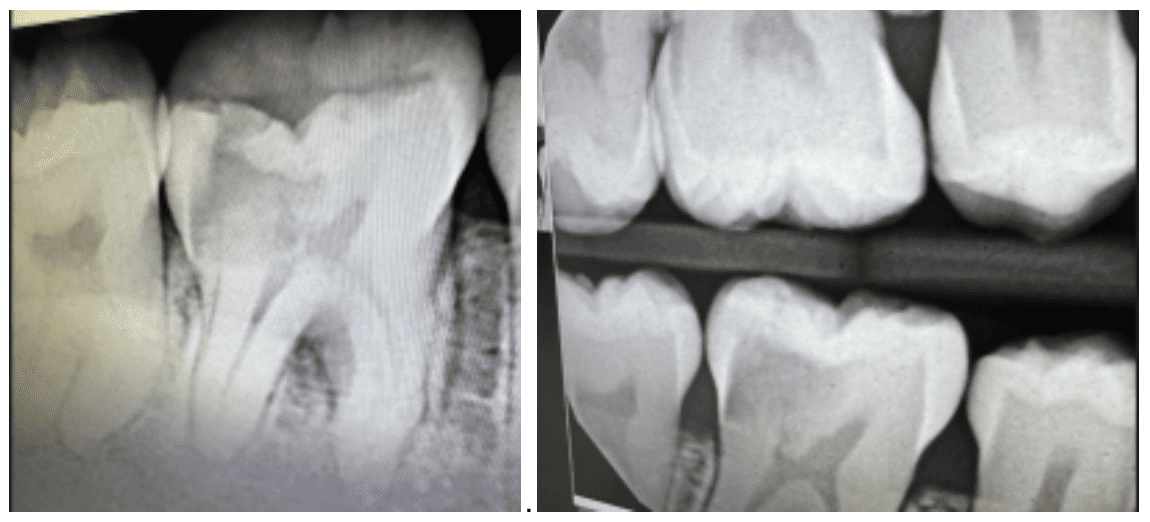
X-ray: Bitewing and PA revealed large DO caries extending into the pulp with furcal radiolucency.

Next Steps
After a thorough clinical exam, I decided to attempt to restore #30 by means of RCT, crown lengthening, and a crown.
However this decision took me some time to come to. I was considering an extraction and placing an implant. The reason is the furcal radiolucency.
When there is a furcal radiolucency, restorability becomes a question as you are losing furcal bone. And most importantly, you do not know what is the cause of the furcal radiolucency. It can be a cracked tooth, perio lesion, vertical root fracture or more.
Being that the probing depth was normal and the patient’s age and oral hygiene, I ruled out perio lesion. And typically cracked teeth with a furcal radiolucency are non-vital, but during the clinical exam the tooth had a slight response to cold test.
This pointed me in the direction that some of the canals were necrosed but others were not yet. This allowed me to assume that this was due to an endodontic origin; as 24% of permanent first molars have an accessory furcal canal.
Patient was willing to attempt to try to save the tooth. A pulpectomy was performed to take the patient out of pain and the pulpal floor was inspected to see fractures which none were found. (Using copious irrigation with 6% sodium hypochlorite under rubber dam and calcium hydroxide in the canals)

2 Month Follow-Up
2 months post pulpectomy, the patient reported all of her symptoms went away. Percussion test was normal. Swelling of gingiva went away and has not come back. Patient was referred for completion of RCT #30 and then to return for crown lengthening and a crown. Patient was ecstatic and so was I.
Being able to save a tooth without performing “herodontics.” Proper consideration of each case is vital to provide the best care for each patient. Being at such a young age, extraction of any tooth should be avoided as long as possible.
Final Thought
Clinical dentistry is not a textbook. You must critically think. This method would not work for every case, but it’s important to use everything in your arsenal to provide the best care. And ultimately constant communication with your patients.
The patient was well informed that at any point this tooth may be non restorable and would need to be extracted. But by involving the patient into the treatment planning, I allowed them to make the decision and I carried out the plan to the best of my abilities.
Keep Reading: Class III Preparation and Restoration: High-Yield Guide for Dental Students